Focus Dual — the device I use at Lumos Skin.
By Anne · Lumos Skin, Basingstoke | 6 minute read
If you have been reading about skin treatments in Basingstoke, you will keep seeing two names: the treatment, and the device. The treatment is what we do. The device is the tool. At Lumos Skin, that tool is the Focus Dual by Lynton, made in Cheshire — and it is unusual because it delivers two different treatments from one machine: HIFU and RF microneedling.
This page is the deep-dive on what the Focus Dual actually is, how each treatment works, what each one is and isn't good for, and why I chose it. If you want the side-by-side against Morpheus8 and 3D DermaForce, that is on the device comparison page.
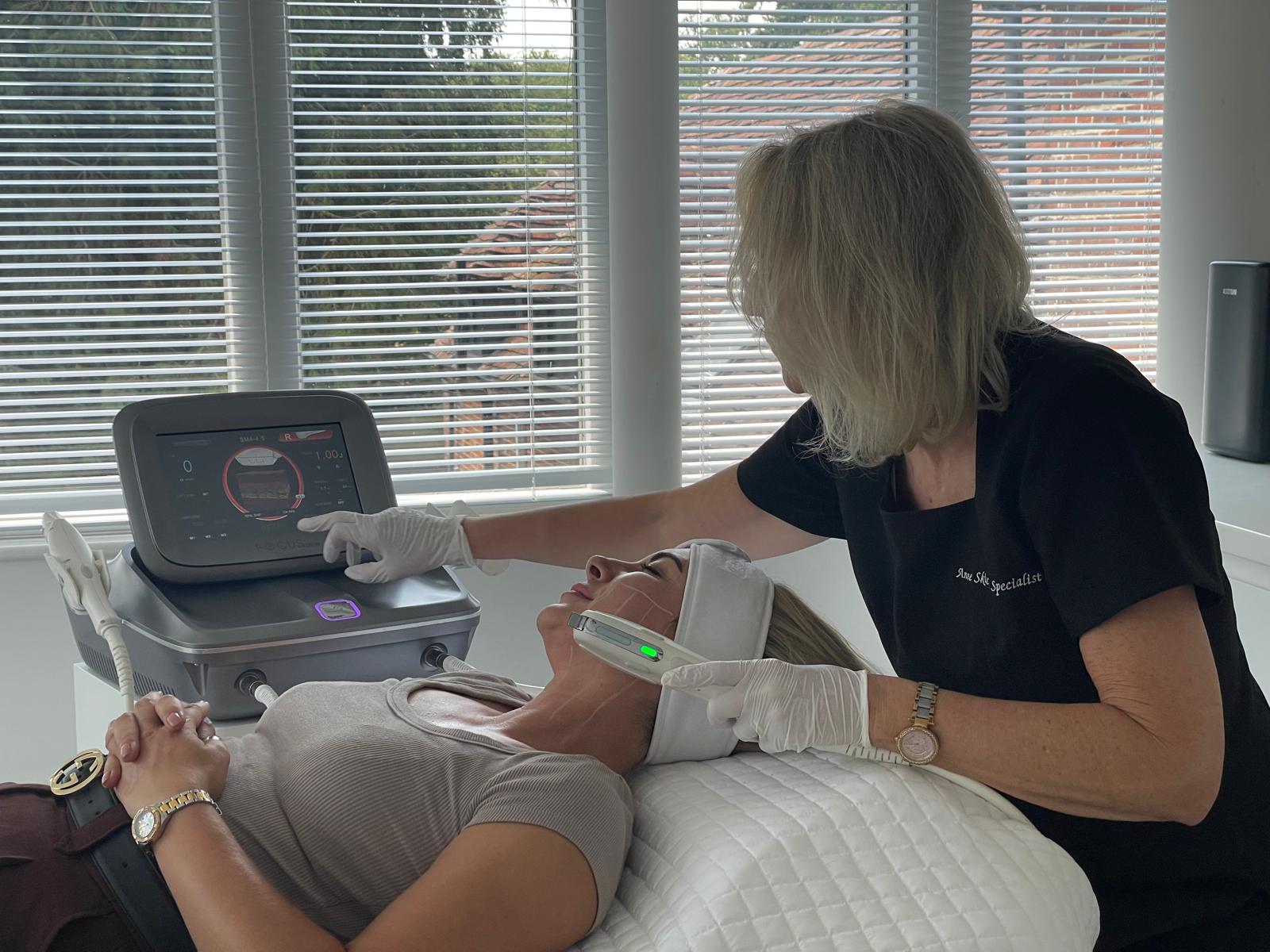
What is the Focus Dual?
The Focus Dual is a medical-grade device built by Lynton Lasers Ltd, a UK manufacturer based in Cheshire. Lynton has been making laser and light-based clinical equipment for over thirty years, and their systems are used in clinical settings across the UK, including NHS dermatology referrals in some areas.
The Focus Dual combines two technologies in one machine:
- High Intensity Focused Ultrasound (HIFU) — focused ultrasound that reaches the deeper supporting layer of the skin to lift and firm. No needles, no anaesthetic.
- Radiofrequency (RF) microneedling — fine sterile needles deliver controlled radiofrequency heat into the mid-skin layers to rebuild collagen and refine texture.
They are separate modes, used for different concerns, but having both on one device means I can plan a treatment around your skin rather than around what a single machine happens to do.
How HIFU works
HIFU uses focused ultrasound energy to heat the deeper supporting layer of the skin — the same layer a surgical facelift works on, but without cutting. That heat triggers a firming and lifting response over the following months. It is a "from the inside out" treatment: you don't see much on the day, but the structure underneath is being retightened.
How RF microneedling works
Fine needles (we are talking 0.5–3.5 mm, adjustable) create controlled micro-channels in the skin, while radiofrequency energy heats the deeper layers. Your skin reads this as a signal to rebuild: fibroblast cells ramp up collagen production, elastin fibres reorganise, and skin quality improves gradually over the following 12 weeks. A course of three gives the change most people are actually looking for.
HIFU vs RF microneedling at a glance
Both are performed on the Focus Dual, but they do different jobs. This is the short version:
| HIFU | RF microneedling | |
|---|---|---|
| What it does | Lifts and firms from depth | Refines texture, scarring, pores |
| Depth reached | Deep supporting layer (SMAS) | Mid-skin layers (0.5–3.5 mm) |
| Anaesthetic | None needed | Mild numbing cream, 15 min |
| Downtime | None | 2–3 hours pinkness |
| Sessions | 1–3, lasts ~a year | Course of 3, 4–6 weeks apart |
| From | £225 per session | £295 per session |
| Best for | Laxity, jawline, brow, firming | Mild laxity, scarring, texture, pores, fine lines |
What HIFU is good for
HIFU reaches deeper, so it is the lifting tool: if you want the lifting-and-firming outcome without the surgery, the non-surgical facelift page covers what to expect.
- Jawline definition
- Skin laxity on the face and neck
- A brow lift
- Overall firming where the skin has started to drift
What RF microneedling is good for
RF microneedling works in the mid-layers, so it is the refining tool:
- Mild to moderate laxity on the face and neck — combining RF microneedling with HIFU gives exceptional results, lifting from depth while refining the surface, rather than relying on one treatment alone.
- Skin texture & pores — rough, uneven texture and visibly enlarged pores respond well. Most people describe their skin as smoother and more refined.
- Fine lines and early crepey texture — particularly around the eyes, mouth and cheeks.
- Acne scarring — particularly rolling and boxcar scars. This is where RF microneedling has the strongest evidence base, and it is the treatment I most often recommend for it.
What the Focus Dual is NOT good for
I will turn people away from a treatment if I do not think it is the right tool. That honesty is part of why I do this job.
Neither mode is the right choice for:
- Pigmentation and redness — IPL is the right tool for sun damage, melasma, thread veins and rosacea. HIFU and RF microneedling don't target pigment well.
- Active acne — treatment over active breakouts spreads bacteria and worsens inflammation. We treat acne scarring once the acne itself is managed, not alongside it.
- Very heavy laxity — HIFU and RF microneedling both have a limit to what they can lift. Where skin has drifted beyond that point, a surgical lift is the only route that will give a meaningful result, and I will say so rather than take your money for a change I can't deliver.
- Pregnancy or breastfeeding — we do not treat during this time. I will see you afterwards.
If you come in for a consultation and I think you need a different treatment — or none at all — I will say so. The treatment room is not a sales floor.
What a session actually feels like
The two treatments feel completely different, so it is worth being clear about both.
A HIFU session
Relaxing. No anaesthetic is needed. You lie back, a cool gel is applied, and the handpiece moves across the skin delivering the ultrasound. Most people feel a gentle warmth and a light tingling or tapping as the energy lands. There is no downtime — you can go about your day straight after.
An RF microneedling session
A mild anaesthetic cream is applied 15 minutes before we start, so the skin is comfortably numb. The handpiece then moves across the treatment area in a systematic pattern. Each pulse feels like a brief, warm prickling sensation — not painful. Most people chat through it. A full face takes about 30–45 minutes.
Straight after: your skin is pink and warm — similar to mild sunburn. This settles within 2–3 hours.
The next 24 hours: You can apply medical grade tinted spf 30 after 8 hours and make-up the next day. Avoid active ingredients (retinoids, AHAs, BHAs, vitamin C) for five days. Use SPF 30+ daily — non-negotiable, your skin is more photosensitive after treatment.
The next 4–12 weeks: this is where the real change happens. Collagen rebuilds gradually. You will not see it day to day, but comparing photos at week 12 against your starting point is when most people have the “oh” moment.
How many sessions do you need?
HIFU: typically 1–3 sessions depending upon severity, with results that last around a year. An annual top-up keeps the effect.
RF microneedling: for most concerns, a course of three sessions, four to six weeks apart, is the right answer. Collagen change needs repeated stimulation to be meaningful. For deeper acne scarring, a fourth session is sometimes worthwhile.
How much does it cost at Lumos Skin?
HIFU starts from £225 per session. RF microneedling with Focus Dual starts from £295 per session, with a course of three recommended for most concerns.
Full pricing and what is included is on the HIFU treatment page and the RF microneedling treatment page.
Why I chose the Focus Dual
I have used, trained on, and researched the RF microneedling and HIFU devices you find in Basingstoke clinics — including Morpheus8 and 3D DermaForce. The full comparison is on the device comparison page, but the short version is this:
- Two treatments, one device. The Focus Dual gives me both HIFU (lifting) and RF microneedling (refining) on the same platform. That means I can plan around your skin — lift and refine, sometimes in the same course — without booking you across two clinics or two machines.
- UK-built and supported. Lynton is a UK manufacturer with proper training, servicing and clinical support. If something goes wrong, parts and expertise are not on a container ship away.
- Medical-grade standards. Lynton's technology is used in clinical settings across the UK, including NHS dermatology referrals in some areas. The build quality and clinical evidence behind the device are stronger than the alternatives.
- Comfort. HIFU needs no anaesthetic and has no downtime. RF microneedling is well-tolerated with mild numbing and only a few hours of pinkness. Neither is the ordeal some clinics make them sound.
- Clinical evidence. The body of clinical papers and case studies behind the Focus Dual is substantial. I want to be confident in what I am putting on someone's face.
That said, the device is only part of the story. Technique, judgement, and the willingness to say "this is not right for you" matter just as much. Any of these devices in the wrong hands will disappoint.
Frequently asked questions
Is the Focus Dual safe?
Yes. The device is CE-marked, manufactured under medical-grade quality standards, and used widely across UK clinical settings. As with any energy-based treatment, safety depends on practitioner training, appropriate settings for your skin, and a proper medical history consultation beforehand. All of which I do.
How long until I see results?
HIFU: a subtle lift builds over two to three months as the deeper layer remodels, and lasts around a year. RF microneedling: you will notice a glow within a week, with the real collagen change building over 8–12 weeks. Photograph yourself at week 12 and compare to day one — that is when most people see the difference they came for.
Can the Focus Dual be used on dark skin tones?
Yes — both HIFU and RF microneedling are generally safe across skin tones. RF microneedling energy is not absorbed by melanin in the same way laser energy is, and HIFU is colour-blind by nature. That said, I always assess skin type and adjust settings accordingly.
Can I combine the two treatments?
Lifting with HIFU and refining with RF microneedling are complementary — different depths, different jobs. I will design a treatment plan around your skin rather than around what I want to sell you, and sequence them safely.
Want to know if the Focus Dual is right for your skin?
A consultation is the honest starting point. I will look at your skin, talk through what is realistic, and recommend what is genuinely right for you — whether that is HIFU, RF microneedling, a combination, a different treatment, or nothing at all.
Book a consultationRelated reading
- Focus Dual vs Morpheus8 vs 3D DermaForce — the side-by-side device comparison
- RF Microneedling treatment page — how it works, pricing and FAQ
- HIFU treatment page — lifting and firming with the Focus Dual
- Acne scarring & skin texture — the concern RF microneedling is strongest for
- HIFU, RF microneedling or IPL — which is right for me? — choosing between treatments
- Real client results — before and after from Lumos Skin treatments
Published: July 2026 · Author: Anne, Lumos Skin · Tags: Focus Dual, Lynton, HIFU, RF microneedling, Basingstoke, device deep-dive